Loading the interactive

Can a lopsided tile cover a floor?
Lay lopsided tiles on a floor, tear off a tracing's corners, then test tiles with more sides.
Lesson Plan
Explore the angle sums of triangles and quadrilaterals, and use them to test which polygons can tile a floor.
Question:
Question:
Question:
Question:
Question:
Question:
Your turn:
How to run it
- Whole class
- Solo
Show what you know
Here is a square and some regular octagons.
In this pattern, all of the angles inside the octagons have the same measure. The shape in the center is a square.
Find the measure of one of the angles inside one of the octagons.
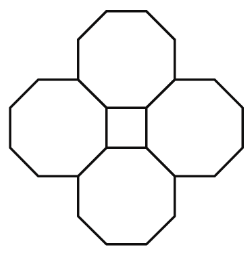
In this pattern, all of the angles inside the octagons have the same measure. The shape in the center is a square.
Find the measure of one of the angles inside one of the octagons.
A common tiling pattern with hexagons is pictured below:
a. A is a hexagon with congruent sides and congruent interior angles. Find the measure of the interior angles in a .
b. Show that equally sized regular hexagons sharing a common vertex can be arranged in the configuration of the above picture.
c. Explain how a single regular hexagon can be by regular hexagons with no spaces and no overlap, as in the picture below:
Triangle is the image of triangle after a rotation around the midpoint of segment . Triangle is the image of triangle after a rotation around the midpoint of segment .
a. Explain why and are .
b. Identify two pairs of in the figure and explain how you know they are congruent.
c. Explain how to use what you know about the in a triangle to figure out the of quadrilateral .
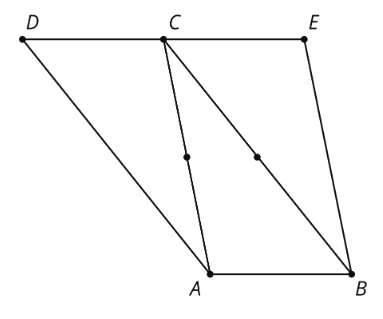
a. Explain why and are .
b. Identify two pairs of in the figure and explain how you know they are congruent.
c. Explain how to use what you know about the in a triangle to figure out the of quadrilateral .
+2 more