Loading the interactive
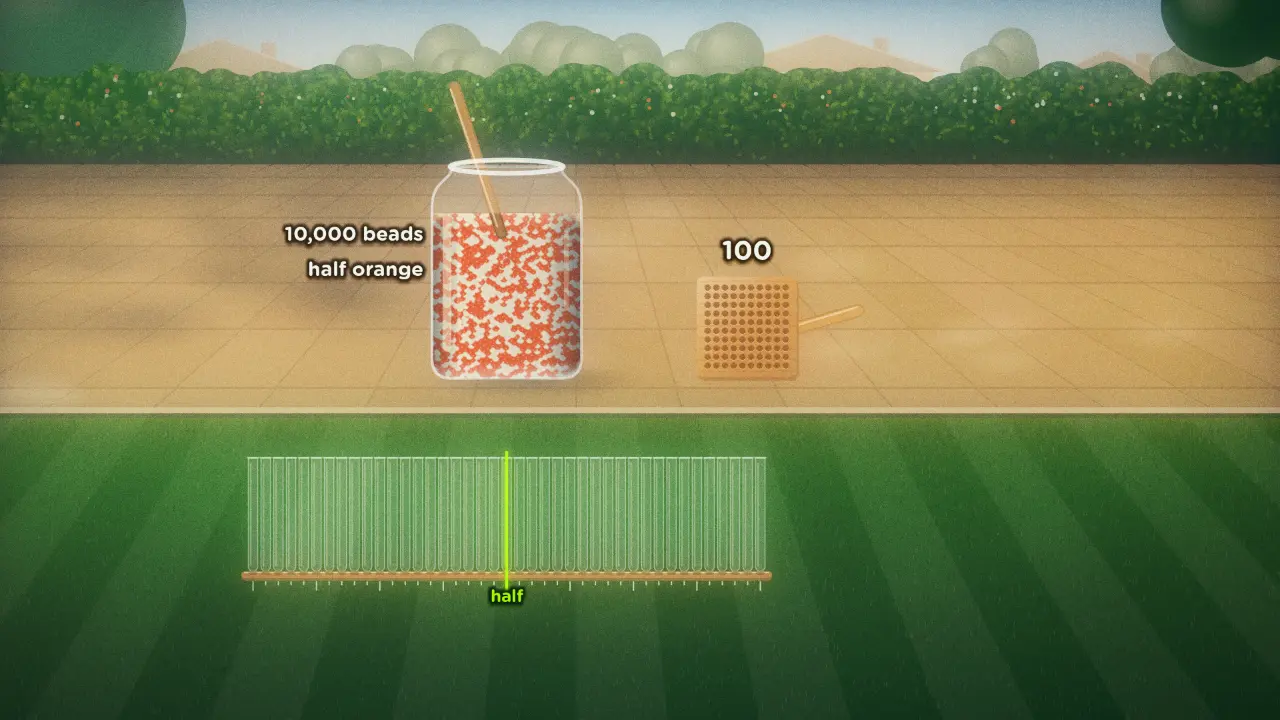
How can a thousand people speak for a whole country?
Sample beads from a jar and a swimming pool, then find out how many people a poll needs.
Lesson Plan
Use a random sample to estimate a population proportion, and develop a margin of error by simulating scoops of beads.
Question:
Question:
Big idea:
Question:
Question:
Question:
Real-world application:
Your turn:
How to run it
- Whole class
- Solo
Show what you know
A streaming service samples randomly chosen users from its more than subscribers and finds that watched a Taylor Swift concert special last month.
Based on this sample, what is the confidence interval for the proportion of subscribers who watched the special?
Round your answers to the nearest thousandth.
A phone manufacturer wants to estimate what proportion of new phones leaving its assembly line have a screen defect. It takes a random sample of phones from a day's production of more than and finds with a screen defect.
Based on this sample, what is the confidence interval for the proportion of phones with a screen defect?
Round your answers to the nearest thousandth.
A sustainability office wants to make a one-sample z interval to estimate the proportion of city residents who compost food scraps. They plan on using a confidence level of 95%, and they want the margin of error to be no more than ±3%.
If we assume , what is the smallest sample size required to obtain the desired margin of error?
+2 more